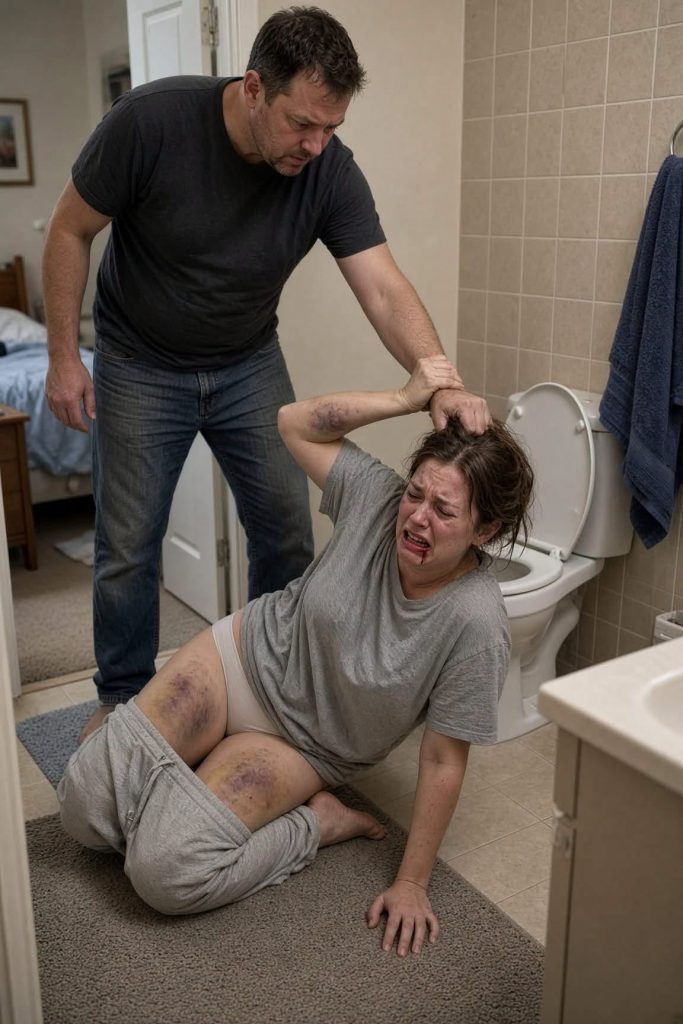
The bathroom door cracked just wide enough for my husband’s fingers to snake through toward the latch.
I moved sideways with my newborn pressed against my chest, trying to keep my body between him and that opening while my bare feet fought for traction on the tile.
The dispatcher was still on my phone.
The sentence might have sounded reasonable to someone who hadn’t heard the recording.
That was the frightening part.
He wasn’t shouting anymore.
He wasn’t dragging me across the floor anymore.
He sounded like the person trying to restore order.
Then the monitor betrayed him again.
His earlier voice came through the speaker.
“Don’t let her make this about the baby. Once she gives him up, she’ll listen.”
For the first time, I could hear both versions of my husband at once.
There was the man outside the door speaking softly.
There was the man on the recording explaining why speaking softly might work.
There was the husband asking me to calm down.
There was the husband who had already decided that taking my son out of my arms would make me easier to control.
He wanted the door open.
He wanted my baby handed over.
He wanted his voice in the hallway to compete with the evidence beside me.
But the monitor kept talking.
My mother-in-law’s recorded voice followed.
“She’ll cry. Let her. She always gives in when she thinks she’s upsetting everyone.”
Almost immediately, her live voice came from the hallway.
She said my name sweetly.
Then she told me I was frightening the baby.
I looked down at him.
He wasn’t screaming anymore.
His breathing still came unevenly, those small newborn breaths that seemed to catch and restart, but his cheek rested against me and his fist stayed curled into my shirt.
I kissed his head.
Then I turned my phone so the dispatcher could hear the monitor better.
I stopped explaining myself.
That small decision felt enormous.
For so long, every accusation seemed to require an answer.
If they said I was emotional, I tried to sound calm.
If they said I was difficult, I tried to explain what had happened.
If they said I was upsetting someone, I tried to fix the feeling before I asked whether the accusation was even true.
Now I had bruises forming on my body, my newborn in my arms, a locked bathroom door between us and them, and their own recorded words describing the pressure they intended to use.
There was nothing left to debate.
My husband tried anger next.
“You’re making this worse.”
Then concern.
“You need to think about our son.”
Then defense.
“My mom was trying to help you.”
The wording changed.
The goal didn’t.
Open the door.
Give them the baby.
Give up the barrier.
I backed farther away and wrapped a bath towel around my son, keeping it snug around his body while making sure his face stayed uncovered.
The dispatcher asked whether the bathroom had another exit.
I looked around even though I already knew the answer.
There wasn’t one.
One door connected us to the rest of the house.
My husband stood beyond it.
For a moment, the hallway quieted again.
Then his mother changed tactics too.
“Enough,” she snapped.
The sweetness vanished.
A metallic scraping sound came from outside.
It was faint, but in that little room every sound seemed magnified.
I could hear my own breathing.
I could hear the fan.
I could hear the monitor’s low electronic hiss between recorded voices.
I could hear my son making tiny noises against my shirt.
Then I heard my husband say something too quietly for me to understand.
His mother answered him clearly.
“You should’ve done this five minutes ago.”
I stared at the thin line of light beneath the door.
A shadow moved across it.
Something small appeared near the floor as their feet shifted.
Then I saw the metal key.
My mother-in-law put it into my husband’s hand.
That key changed the meaning of the locked door instantly.
Until then, the lock had been the one thing I controlled.
I had closed it.
I had turned it.
I had chosen who stayed outside.
Now they had a way to challenge even that.
The key touched the lock before I could decide where else to stand.
I tightened the towel around my son and stepped backward toward the tub.
There wasn’t much space to create, but I used all of it.
I kept myself between him and the doorway.
The dispatcher was still connected.
Then the baby monitor played my husband’s earlier words again.
“If she tries to leave with him, I’ll stop her at the front door.”
This time, I wasn’t the only person hearing them.
The dispatcher heard them too.
“Keep the line open,” she told me.
Her voice was calm, but it didn’t ask me to convince anyone outside that I deserved to be left alone.
It simply kept me connected to someone beyond that house.
Outside, my husband turned the key partway.
Then he stopped.
His mother whispered, “What are you doing?”
He didn’t answer her.
Instead, he leaned closer to the bathroom door and said my name again.
That same careful voice.
That same performance of patience.
“Put the baby down. Then we’ll talk.”
“No.”
Again, one word was enough.
The lock clicked.
My son shifted against me, and I raised him slightly higher against my chest.
My feet slid a little on the smooth tile as I moved sideways.
I corrected my balance without taking my arm away from him.
There was nowhere to run inside the bathroom.
There was only positioning.
Distance.
The tub behind me.
The sink beside me.
The phone carrying the open call.
The monitor carrying their earlier voices.
The towel around my baby.
And the door.
Everything had become painfully simple.
My husband was on one side.
My son and I were on the other.
The handle began to lower.
I watched it move.
Slowly.
Deliberately.
The person turning it was the same person whose voice on the monitor had already said he would stop me if I tried to leave with our child.
That fact steadied me more than any reassurance could have.
I didn’t have to decide whether his current tone was sincere.
I didn’t have to interpret the concern in his voice.
I didn’t have to guess what his mother meant when she said she was trying to help.
Their earlier conversation had already answered the question I had spent too much energy asking myself.
Were they trying to calm the situation, or were they trying to control me?
The words from the monitor had made that distinction brutally clear.
The door moved inward.
Only a few inches.
Enough for hallway light to widen across the bathroom floor.
Enough for me to see part of my husband’s arm.
Enough for him to reach inside.
He didn’t reach for me first.
He didn’t reach for our son.
His hand went toward the lock.
Maybe he intended to finish opening the door.
Maybe he intended to keep me from securing it again.
I didn’t know, and I didn’t need to pretend that I did.
What I knew was already enough.
He had dragged me by my hair.
He had held me on the floor.
His mother had taken my crying newborn while I was pinned down.
She had thrown the baby onto the mattress.
They had talked beforehand about using my exhaustion against me.
They had discussed preventing me from leaving with him.
They had repeatedly demanded that I surrender my son.
And now a key they controlled had opened the only locked barrier between us.
My phone remained connected.
My baby remained against my chest.
The monitor remained beside me.
Those three ordinary objects had become the only things in that room that did not require me to accept somebody else’s version of what was happening.
The phone carried another person who could hear me.
The towel kept my son warm against me.
The monitor carried voices from a moment when my husband and his mother had believed I wasn’t listening.
I had spent the first part of that morning trying to survive what they were doing.
Now I was also trying to hold onto what I knew.
Fear has a strange way of making simple facts feel negotiable when the person frightening you insists that you’re the unreasonable one.
The recording removed that escape route for them.
They could change their tone.
They could change their explanation.
They could tell me I was frightening the baby.
They could tell me his mother had been helping.
They could tell me I was making things worse.
But they couldn’t make me unhear themselves.
That mattered more with every inch the door moved.
My husband’s fingers came farther through the opening.
I shifted again, keeping my son’s head protected against my chest and my body angled between him and the gap.
I could feel the ache in my shoulder when I moved.
My swollen cheek throbbed with every heartbeat.
My lip stung whenever I breathed through my mouth.
My scalp still burned.
Those sensations were no longer separate injuries competing for my attention.
They were part of one fact.
This had already become physical once.
I could not assume the calm voice at the door meant it would stay calm now.
So I didn’t argue.
I didn’t explain.
I didn’t bargain.
I held my son.
I kept the call open.
I watched the hand coming through the gap.
And while my husband’s fingers reached toward the bathroom lock, the baby monitor beside me continued to hiss softly with the recorded proof of what he and his mother had planned before either of them ever told me to calm down.